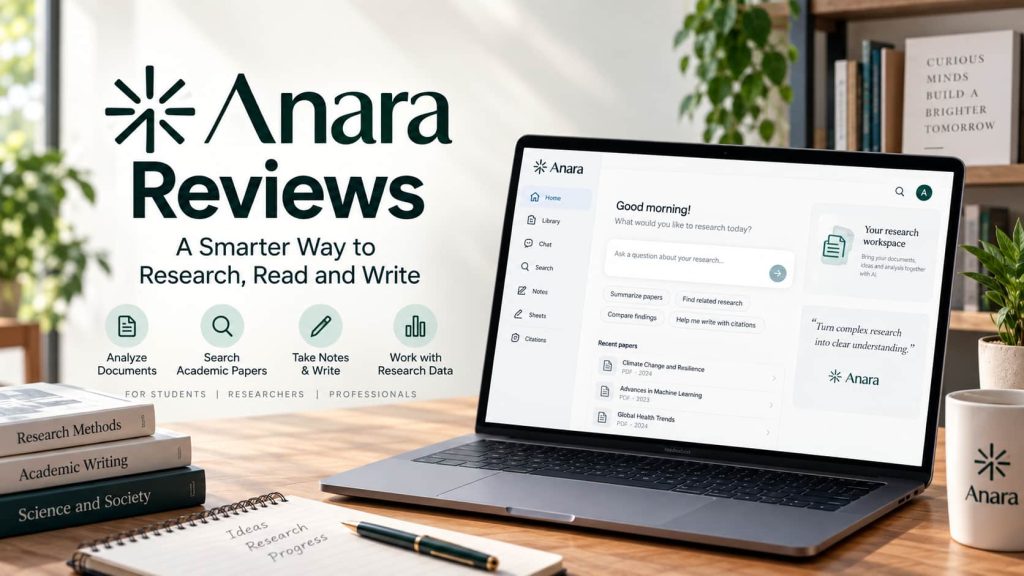
Research can become difficult when you need to work through dozens or even thousands of papers, compare findings, organize notes, and keep track of citations. Anara is designed to bring these tasks into one research-focused workspace. Instead of functioning primarily as a general chatbot, Anara combines document management, academic search, AI-assisted analysis, note-taking, citations, and writing tools.
In this Anara review, we look at what the platform offers, how its research workflow works, its main features, potential limitations, and who may find it useful.
What Is Anara?

Anara is an AI-powered research workspace designed for scientists, students, academics, and professionals who work with large amounts of research material. The platform lets users import documents, organize a research library, ask questions about their sources, search academic literature, create notes, and write documents with citations.
One of the main ideas behind Anara is keeping research connected to its original sources. Its answers can include inline citations that point users back to the relevant passages in their documents, making it easier to check where information came from.
The platform has also expanded beyond simple PDF conversations. Its newer research workflow is designed to search a user’s library, the web, and academic sources while helping with larger research projects.
How Does Anara Work?
Anara starts with a research library where users can bring together papers, PDFs, notes, websites, and other sources. Users can import documents from supported reference-management tools, add papers using a DOI or URL, or capture web pages through supported browser features.
Once material is inside the workspace, users can ask questions about individual documents, folders, or larger collections.
For example, a researcher could ask:
-
- What are the main findings across these studies?
- Which papers discuss a particular methodology?
- What limitations appear repeatedly?
- How do the results differ between these studies?
- Which sources support this conclusion?
Anara can then search the relevant material and provide an answer connected to the available sources.
This approach can be useful when the goal is not simply getting an answer, but understanding where that answer comes from.
What Features Does Anara Offer?
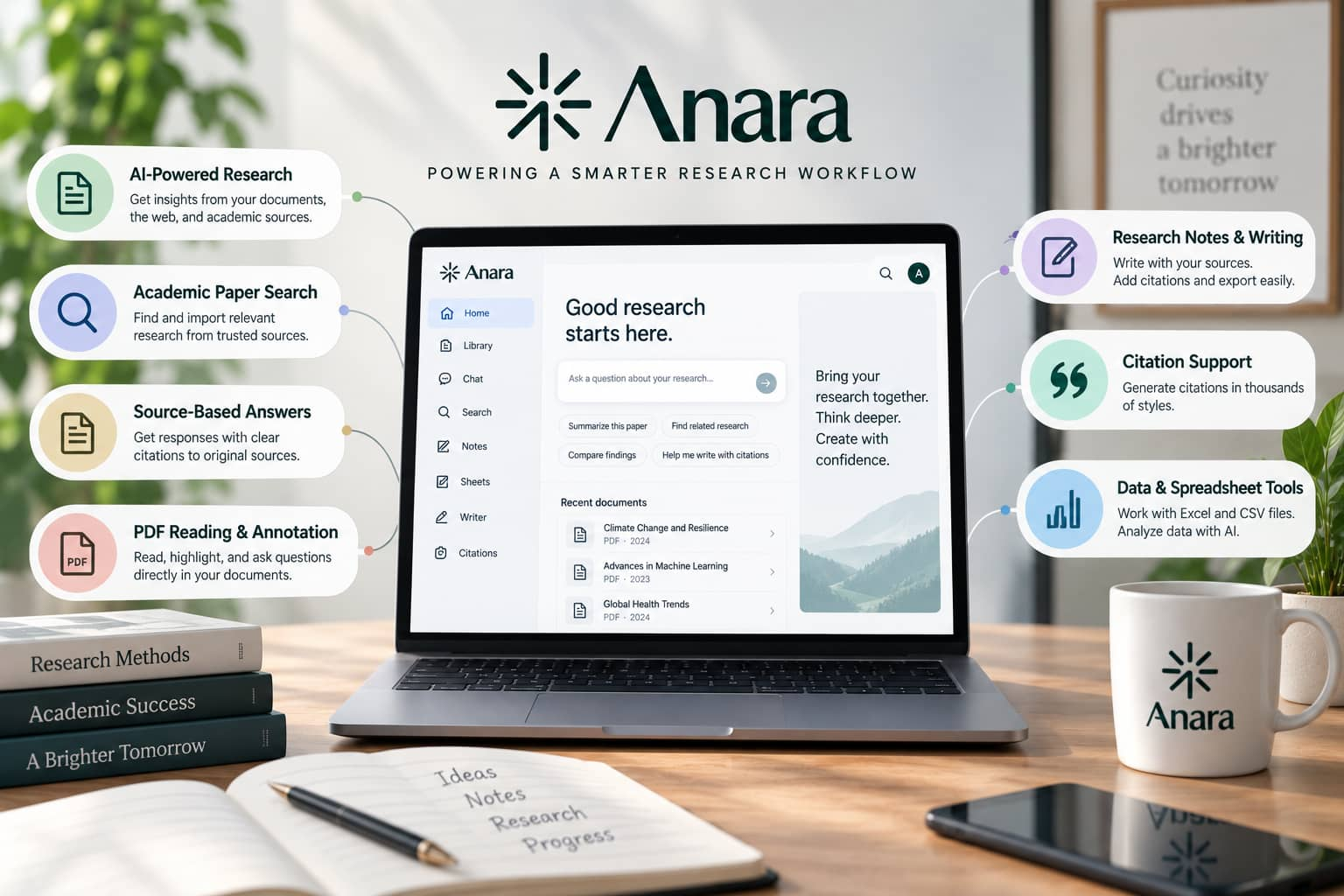
AI-Powered Research
Research is the central focus of Anara. Its research tools can search across a user’s library, web sources, and academic material to investigate complex questions. The platform is designed to synthesize information instead of requiring users to manually review every search result.
Anara has also developed tools for working with large collections of files, making the platform suitable for research projects that involve substantial amounts of source material.
Academic Paper Search
Finding relevant academic papers is another important part of the platform.
Anara can search academic sources and help users discover relevant research. Search results can include citations, and users can bring useful papers into their research library after reviewing them.
This can reduce the need to move repeatedly between different research databases and a separate AI tool.
Source-Based Answers
One of the important features in Anara reviews is its focus on source verification.
When working with documents, the platform can provide citations that lead users back to passages supporting an answer. This makes it easier to inspect the underlying material instead of accepting an AI-generated statement without checking it.
This does not remove the need for human verification, especially when dealing with important scientific or academic claims, but it can make the checking process more convenient.
PDF Reading and Annotation
Anara includes an integrated PDF reading experience where users can read papers, highlight passages, add comments, and interact with AI alongside the document.
This is useful for people who prefer keeping their reading and research questions in the same workspace.
Instead of opening a paper in one application and an AI assistant in another, users can work with the document and ask questions within the same research environment.
Research Notes and Writing
Anara also combines research with writing.
Its note editor lets users write while keeping access to their research library. Users can search for sources, insert citations, and prepare documents for export into different formats.
The writing assistant is designed to work from imported research rather than simply generating unrestricted text. Users can also focus the AI on their own research library when they want responses based specifically on their collected sources.
Citation Support
Citation management is particularly important for academic work.
Anara can generate formatted citations and supports a wide range of citation styles. Document information can also include details such as authors, publication information, DOI, publication date, and other metadata.
Having citation tools available inside the research environment can save time when moving from research notes to a finished document.
Data and Spreadsheet Tools
Anara has also expanded into structured data work.
Its spreadsheet tools allow users to work with Excel and CSV files, edit cells, use formulas, work across multiple sheets, and export files. Research workflows can also use AI to analyze spreadsheet data.
This makes the platform broader than a traditional academic PDF reader and gives users another way to work with research data.
Anara Reviews: What Is the Research Experience Like?
The research experience is built around keeping sources, analysis, and writing connected.
A typical workflow might look like this:
-
- Import research papers into the library.
- Organize documents into folders.
- Ask questions about individual papers or groups of papers.
- Search for additional academic sources.
- Compare findings across documents.
- Save useful information as notes.
- Write a research document.
- Add citations while writing.
- Review claims against the original sources.
- Export the completed work.
This workflow can be useful for literature reviews, thesis research, scientific reports, and projects that involve large collections of documents.
Anara’s research approach encourages users to start with clear research questions, gather relevant sources, use AI to screen and summarize information, verify important details, and apply human judgment before completing the final work.
Anara for Literature Reviews
Literature reviews are one of the clearest use cases for Anara.
A literature review can involve finding relevant studies, understanding methodologies, comparing results, identifying disagreements, and locating research gaps. Doing all of this manually can take substantial time.
Anara’s research workflow is designed to help with these steps by searching across multiple sources and synthesizing information into structured responses. The platform can also maintain research context between questions, allowing users to begin with a broad topic and gradually move toward more specific questions.
For example, a researcher studying renewable energy could begin by asking for major research themes, then examine specific technologies, compare methodologies, and investigate gaps in existing research.
The important point is that AI-assisted research should complement, rather than replace, careful reading and evaluation of the original studies.
Anara for Students
Students can use Anara for several research-heavy tasks.
It can help with:
-
- Understanding difficult academic papers
- Summarizing large collections of sources
- Preparing literature reviews
- Finding supporting evidence
- Organizing research notes
- Comparing studies
- Creating citations
- Preparing research papers
- Reviewing source material
The ability to ask questions directly against uploaded documents can be particularly useful when a student has several papers covering the same subject.
However, students should still follow their institution’s rules regarding AI-assisted academic work. AI-generated material should not automatically be treated as original academic writing.
Anara for Researchers and Professionals
For professional researchers, one of the main benefits may come from handling large research libraries.
Anara is designed for researchers in academia and industry, including scientific literature workflows and internal research projects.
The platform can bring papers, notes, web information, citations, and writing into one environment. Researchers working across multiple projects may also benefit from searchable folders and organized research sessions.
The ability to connect different research sources can also reduce the amount of manual switching between databases, document readers, note-taking applications, and writing tools.
Potential Advantages of Anara
Based on its feature set, several aspects of Anara stand out.
Research-focused design: Anara is built specifically around research workflows rather than general-purpose conversation.
Source traceability: Inline citations can help users locate the passages behind AI-generated answers.
Large research libraries: The platform is designed to work across substantial document collections.
Academic search: Users can search academic material and bring relevant papers into their research environment.
Integrated writing: Research and writing can happen inside the same workspace.
Citation tools: Citation creation and formatting are incorporated into the workflow.
Data analysis: Spreadsheet support adds another option for research involving structured datasets.
Potential Limitations to Consider
Anara is not necessarily the right tool for every type of user.
First, its feature set is strongly oriented toward research. Someone who only needs occasional general AI assistance may not need a specialized research workspace.
Second, source-grounded AI still requires human review. Citations make verification easier, but researchers should inspect important claims, methods, data, and conclusions in the original sources.
Third, learning the full platform may take some time because it includes several components, including research tools, document libraries, notes, citations, web search, academic search, and data tools.
Finally, research quality still depends partly on the quality and relevance of the sources being analyzed. An AI research platform can help organize and synthesize evidence, but it does not replace scholarly judgment.
Is Anara Worth Considering?

Anara is built for people who regularly work with academic papers, research documents, citations, and large collections of information. Its combination of AI research, document analysis, academic search, source-linked answers, note-taking, writing, and citation management provides a broader workflow than a basic PDF chatbot.
Its research and data features also make it suitable for projects that go beyond simply summarizing individual documents.
For students, researchers, scientists, and professionals who spend significant time searching, comparing, organizing, and writing from source material, these capabilities may fit naturally into an existing workflow.
Final Thoughts on Anara Reviews
Anara takes a research-first approach to AI by connecting document analysis, academic search, source verification, writing, and organization in one workspace. Its emphasis on citations and source-grounded responses is particularly relevant for research where being able to check the evidence matters.
The platform is not a substitute for reading papers or applying critical judgment. Instead, its main value is helping users navigate large amounts of research material more efficiently.
For anyone evaluating Anara, the most relevant questions are how much research they handle, how large their document library is, how important citation traceability is to their work, and whether they want research, analysis, and writing tools in one place.
Overall, Anara is positioned as a specialized research workspace for people who need to work deeply with scientific and academic information, rather than simply another general-purpose AI chatbot.