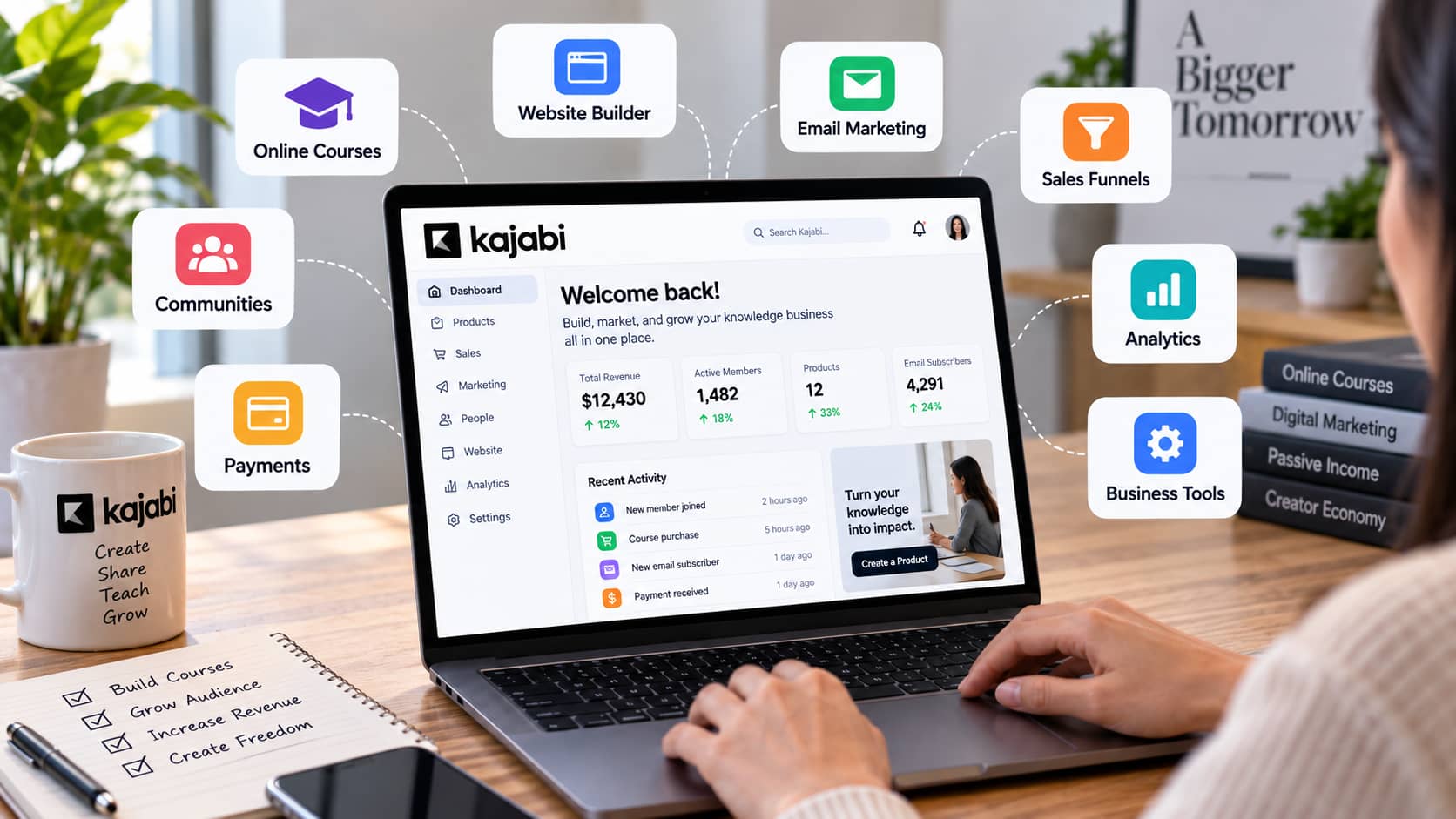
If you are searching for Kajabi reviews, you are probably comparing platforms for selling online courses, coaching programs, memberships, or other digital products. Kajabi has built its reputation around an all-in-one approach, combining course creation, websites, email marketing, sales funnels, payments, community features, and other business tools under one platform.
Unlike services that focus mainly on course hosting, Kajabi is designed to help creators manage more of the business side from one dashboard. The company describes Kajabi as a platform for knowledge entrepreneurs, including coaches, consultants, educators, course creators, and other experts.
But an all-in-one platform also raises an important question: does Kajabi provide enough value to justify its subscription cost? In this Kajabi review, we look at its features, user experience, pricing, advantages, limitations, and the types of businesses that may benefit from using it.
What Is Kajabi?

Kajabi is an online business platform designed for people who want to turn their knowledge or expertise into digital products.
Instead of purchasing separate software for a website, online courses, email campaigns, landing pages, funnels, payments, and communities, Kajabi brings many of these functions together.
The platform can be used to create and sell products such as:
-
- Online courses
- Coaching programs
- Memberships
- Digital content
- Communities
- Podcasts
- Other knowledge-based products
This all-in-one approach is one of the main reasons Kajabi continues to attract professional creators and online businesses.
Independent comparisons also commonly describe Kajabi as a platform that combines course hosting with websites, email marketing, landing pages, sales funnels, and checkout tools.
Kajabi Reviews: What Features Does It Offer?
Online Course Creation
Course creation is one of Kajabi’s core functions. Creators can organize educational material into structured digital products and deliver content to customers through a branded learning experience.
This makes the platform useful for coaches, consultants, educators, and experts who want to package their knowledge into a paid program.
Instead of manually combining a video-hosting service, website, payment system, and customer management tools, creators can manage much of the process through Kajabi.
Website and Landing Page Builder
Kajabi also includes tools for building websites and landing pages.
Users can create pages for their businesses, products, lead generation campaigns, and promotional offers without necessarily building everything from scratch with separate website software.
For creators who want their website and digital products connected within the same ecosystem, this can simplify the setup process.
Email Marketing
Email marketing is another major component of Kajabi.
Creators can communicate with subscribers and customers, organize contacts, create campaigns, and use automated marketing workflows.
This is particularly useful when a business relies on email to promote courses, coaching programs, memberships, or other digital products.
The platform’s integrated marketing tools are frequently highlighted in comparisons with course-focused competitors because Kajabi is designed to cover both product delivery and customer acquisition.
Sales Funnels
Kajabi includes funnel-building capabilities that allow creators to connect landing pages, offers, emails, and checkout experiences.
A typical customer journey might begin with a visitor discovering a free resource, joining an email list, receiving a series of emails, and eventually purchasing a course or coaching program.
Having these components within the same platform can reduce the need to connect multiple third-party services.
Payments and Checkout
Selling digital products requires a reliable way to accept payments and manage purchases.
Kajabi provides checkout functionality as part of its platform. The company also promotes Kajabi Payments as an integrated payment option, while processing fees can vary depending on the country and payment provider.
For creators, having checkout connected directly to products, customers, and marketing activities can make administration easier.
Community Features
Kajabi also provides community functionality for creators who want to build a member environment around their products.
A community can be useful for course discussions, member interaction, additional resources, and ongoing engagement.
However, independent comparisons point out that community and live-teaching capabilities may not be as central to Kajabi’s original product design as its courses and marketing tools.
Creators who place community interaction at the center of their business may therefore want to compare Kajabi with platforms specifically built around community experiences.
AI Tools
Kajabi has also expanded its AI capabilities. These tools are intended to assist creators with areas such as content development, course outlines, landing pages, and marketing copy.
For someone launching a digital product, AI-assisted creation can reduce the time needed to move from an idea to a structured offer.
Kajabi Pricing
Pricing is an important part of most Kajabi reviews because the platform sits at the premium end of the creator-platform market.
According to Kajabi’s current pricing page, the plans include Basic, Growth, and Pro. With annual billing, the displayed prices are currently $143 per month for Basic, $199 per month for Growth, and $399 per month for Pro. Monthly billing is higher, at $179, $249, and $499 respectively.
The plans differ mainly in capacity and available features.
The Basic plan includes up to five products, 2,500 contacts, one website, one community, and two administrators. Growth increases capacity to 50 products and 25,000 contacts, while Pro offers unlimited products, 100,000 contacts, three websites, three communities, and additional administrative capacity.
Kajabi also introduced pricing changes in January 2026, with the company explaining that the updated plans included expanded limits, additional features, and changes to payment processing.
Because software pricing can change, it is worth checking Kajabi’s current pricing page before subscribing.
Kajabi Reviews: What Are the Advantages?
All-in-One Business Platform
One of Kajabi’s biggest advantages is consolidation.
Instead of managing several subscriptions and integrations, creators can use one platform for many core business functions.
Kajabi itself explains that the platform was created to reduce the need for a collection of separate tools for websites, courses, email, payments, funnels, and communities.
Strong Marketing Features
Creators who actively market their products may appreciate having email marketing, landing pages, funnels, and checkout connected together.
This can make it easier to build a complete customer journey.
Professional Presentation
Kajabi is designed around businesses that want to sell knowledge products under their own brand. The combination of websites, landing pages, courses, and marketing tools can create a consistent experience for customers.
Reduced Technical Complexity
Managing multiple platforms can create technical issues involving integrations, logins, tracking, payments, and customer data.
Kajabi’s integrated approach can reduce some of that complexity.
Kajabi Reviews: What Are the Limitations?
Higher Subscription Cost
The biggest consideration for many smaller creators is price.
With the current Basic plan starting at $143 per month when billed annually, Kajabi requires a meaningful recurring investment.
If you are only selling one simple course, a more specialized course platform may provide enough functionality at a lower cost.
Some Features May Be More Than You Need
An all-in-one platform is useful when you need multiple business tools. However, creators who only require course hosting may end up paying for capabilities they rarely use.
Recent comparisons of Kajabi alternatives frequently highlight price and the fact that some creators do not need the complete marketing suite.
Community May Not Be the Main Strength
Kajabi offers community functionality, but creators focused heavily on peer interaction, cohort learning, or community-led education may want to compare its tools with platforms built specifically around those experiences.
Independent reviews have noted this distinction when comparing Kajabi with community-focused alternatives.
Kajabi vs. Other Online Course Platforms
Kajabi competes with a wide range of platforms, including Thinkific, Teachable, LearnWorlds, Podia, Mighty Networks, and other creator-business solutions.
The main difference is often the scope of the platform.
A course-focused service may concentrate heavily on course creation and student management. A community platform may prioritize discussions and member engagement. A marketing platform may focus on funnels and automation.
Kajabi attempts to combine many of these areas.
That makes the comparison less about finding a platform with the largest number of features and more about determining which tools your business actually needs.
Who Should Consider Kajabi?
Kajabi may be worth considering if you are:
-
- A coach selling structured programs
- An educator creating paid courses
- A consultant packaging expertise into digital products
- A creator building memberships
- An expert who needs email marketing and sales funnels
- An established creator looking to consolidate several tools
- A business selling multiple types of digital products
For these users, the value of an all-in-one platform may be more significant than simply comparing the monthly subscription price.
Who Might Look for a Kajabi Alternative?
A different platform may make more sense if you:
-
- Are launching your first inexpensive course
- Only need basic course hosting
- Have a very small audience
- Primarily need a community platform
- Already have a website and email system
- Want extensive customization beyond Kajabi’s standard setup
- Need specialized educational features
Independent 2026 comparisons continue to highlight alternatives such as Thinkific, Teachable, LearnWorlds, Podia, and community-focused platforms, depending on the creator’s requirements.
What Do Kajabi Reviews Say About Value?
Public review data provides another perspective. Capterra’s Kajabi listing, updated in August 2026, reports an overall rating of 4.4 out of 5 from 230 reviews, with individual categories covering ease of use, customer service, features, and value for money.
These ratings provide useful context, but review scores should not be treated as a substitute for evaluating your own requirements. A platform that works well for an established coaching business may not offer the same value to someone selling a single small course.
The subscription cost, number of products, audience size, marketing requirements, and desired customer experience all matter.
Is Kajabi Worth Considering?

Kajabi is built for creators who want more than a simple course-hosting system. Its combination of courses, websites, email marketing, funnels, checkout, communities, and business tools makes it possible to operate many parts of a digital knowledge business from one platform.
The trade-off is cost. Kajabi’s current pricing places it firmly in the premium category, so smaller creators should consider whether they will actually use enough of the platform to justify the monthly expense.
For someone building a broader online business around courses, coaching, memberships, and marketing, the all-in-one structure can be appealing. For someone who only needs basic course delivery, comparing alternatives may be worthwhile.
Final Thoughts on Kajabi Reviews
Kajabi stands out because it treats online courses as part of a larger digital business rather than as a standalone product. Its combination of course creation, websites, marketing, funnels, payments, and community tools gives creators a centralized place to manage their online business.
The main question is not simply whether Kajabi has useful features. It is whether those features match your business model and justify the subscription cost.
Before signing up, consider how many products you plan to sell, how large your audience is, whether you need built-in marketing tools, and whether you will use the platform beyond basic course hosting. Comparing those requirements with Kajabi’s current plans can help you determine whether the platform fits your business.